If you’ve ever run a Facebook ad and gotten a spreadsheet full of names and phone numbers that go nowhere, you’re not alone. Every week, we hear the same complaint from Indian business owners: “Leads aa rahe hain, but sales nahi ho rahi.” The problem usually isn’t the platform itself it’s how the campaign, targeting, and follow-up process are set up.
As an agency that has managed Meta ad accounts across categories from local service businesses to e-commerce and B2B we’ve seen what consistently works and what quietly burns budget. This guide breaks down exactly how to get leads from Facebook Ads in the Indian market, without the fluff.
Why Facebook Ads Work for Lead Generation in India
India has one of the largest Facebook and Instagram user bases in the world, spread across metros, Tier 2 cities, and increasingly Tier 3 towns. That scale, combined with Meta’s targeting tools, makes it possible to reach a genuinely qualified audience at a lower cost than most other paid channels provided the campaign is built correctly.
The other advantage specific to Meta Ads for lead generation is friction. A user doesn’t need to leave the app, load a slow landing page, or type out their details manually. This alone significantly improves how many people complete the process, which is exactly why lead ads remain one of the most reliable formats for capturing demand quickly.
Types of Facebook Lead Ads You Should Know
Before setting up anything, you need to pick the right lead capture method. There are three main options:
1. Instant Form (On-Facebook Lead Ads)
The form opens inside Facebook/Instagram itself, pre-filled with the user’s name, phone number, and email. Fastest to fill, highest volume, but generally lower intent people submit without much thought.
2. Landing Page Ads
The ad sends traffic to your website or a dedicated landing page with a form. Slightly more friction, but usually better-qualified leads because the user has to actively type in their details.
3. WhatsApp/Messenger Lead Ads
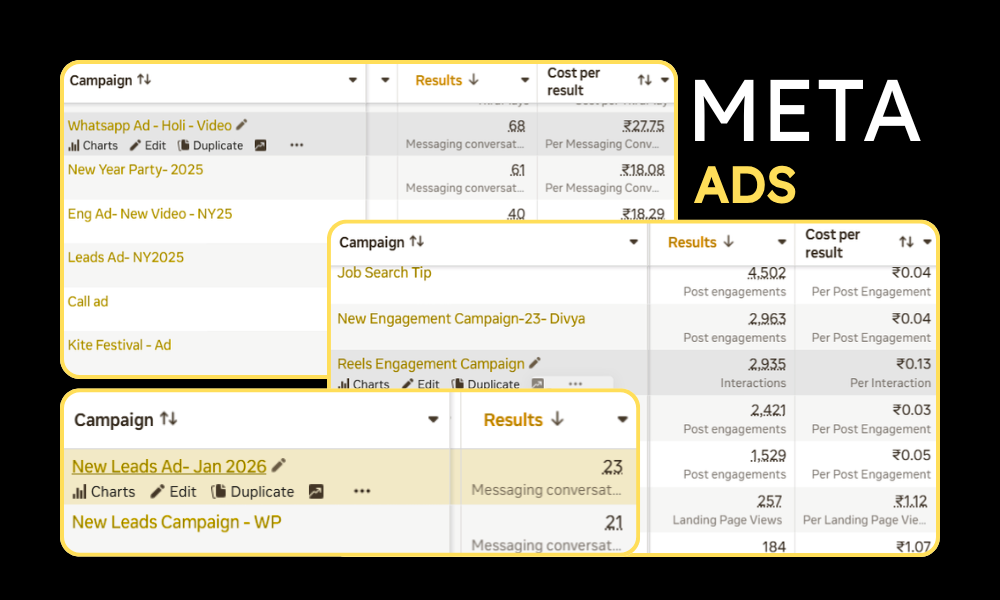
The ad opens a WhatsApp or Messenger chat instead of a form. This works exceptionally well in India, where people are far more comfortable continuing a conversation on WhatsApp than filling out a form. It also allows your sales team to start qualifying the lead immediately.
Our recommendation: if you’re a service business (real estate, education, healthcare, coaching, local services), start with WhatsApp lead ads or a short Instant Form with 1–2 qualifying questions. If you’re an e-commerce or B2B brand collecting leads for a sales team, a landing page with a CRM-connected form tends to filter out low-intent submissions better.
How Much Do Facebook Leads Cost in India
This is the question every business owner asks first, and the honest answer is: it depends heavily on your industry, city tier, and offer.
As a rough benchmark based on campaigns we’ve run across categories:
Industry-wise Approx. Cost Per Lead:
Local services (salons, clinics, coaching centres) — ₹50 – ₹250
Real estate — ₹300 – ₹1,200+ (varies by ticket size and city)
Education / courses — ₹100 – ₹500
E-commerce / D2C — ₹80 – ₹300 (often tracked as cost per purchase instead)
B2B / high-ticket services — ₹300 – ₹1,500+
Costs are typically lower in Tier 2/3 cities and higher in metros like Mumbai, Delhi, and Bengaluru, simply due to competition for ad inventory. If your cost per lead is running significantly above these ranges, the issue is almost always weak creative, broad or irrelevant targeting, or a form that’s asking for too much information upfront.
(Link here if you have a dedicated “Facebook Ads Cost Calculator” or pricing/cost guide page.)
Quick Setup: Business Manager and Pixel
You don’t need a deep tutorial here, just the essentials:
- Set up a Meta Business Manager account and link your Facebook Page and Instagram account.
- Install the Meta Pixel (or Conversions API) on your website if you’re using landing pages this lets Facebook learn who converts and optimize accordingly.
- Verify your domain in Business Manager if you’re running landing page ads.
- Add payment method and confirm your ad account is in good standing before scaling spend.
This is a one-time setup. Once it’s done, you shouldn’t need to touch it again unless you’re adding new pages or ad accounts.
Building a High-Converting Lead Campaign
When creating your campaign, choose the Leads objective in Ads Manager not Traffic or Engagement, which optimize for the wrong outcome. Within this:
- Choose Instant Form, Website, or Messaging as your conversion location, based on which lead type you picked earlier.
- Use Highest Volume bidding if you’re just starting and need data, then switch to Cost Per Result Goal once you know your target CPL.
- Structure your campaign with 2–3 ad sets testing different audiences, and 3–4 ad creatives per ad set. This gives Meta’s algorithm enough variation to find what works without spreading budget too thin.
Audience Targeting for Indian Markets
Targeting is where most Indian businesses either win or waste money. A few principles that consistently work:
- Start broader than you think. Meta’s algorithm is good at finding intent signals on its own. Overly narrow interest targeting often backfires by limiting reach and inflating costs.
- Use location targeting by city tier, not just “India.” A Tier 1 city audience behaves very differently from a Tier 2/3 audience in terms of price sensitivity and response to offers.
- Build a Lookalike Audience once you have at least 100 past customers or leads. This is usually the single biggest lever for lowering cost per lead once your account has data.
- Language matters. Running the same English-only ad copy across all of India often underperforms. Testing Hindi or regional-language variants in Tier 2/3 markets frequently improves both cost and lead quality.
Ad Copy That Converts
Indian audiences respond well to copy that’s direct, benefit-led, and locally relevant. A few things that consistently move the needle:
- Lead with the outcome, not the feature. “Get your dream home in Whitefield under ₹50L” works better than “3BHK apartments now available.”
- Use urgency and social proof where genuine limited slots, festive offers, or “500+ families trust us” type lines.
- Keep the CTA specific: “Get Free Quote,” “Book a Free Demo,” or “Chat on WhatsApp” outperforms a generic “Learn More.”
- Test a Hindi/Hinglish variant of your best-performing English ad this alone often improves CTR in non-metro targeting.
Creative and Video Strategy
Static images can work, but short-form video consistently outperforms for lead generation on Meta in 2026. A few practical tips:
- Keep videos under 15–20 seconds, vertical format (9:16), designed for sound-off viewing with captions.
- Show the product, service, or result in the first 2–3 seconds this is where most viewers decide to keep watching or scroll past.
- Refresh creatives every 2–3 weeks to avoid ad fatigue, especially if you’re spending consistently.
- User-generated content or testimonial-style videos tend to build more trust than polished studio ads, particularly for service businesses.
Lead Form Optimization: Reducing Junk Leads
This is the single most common complaint we hear: “leads toh aa rahe hain but zyadatar fake ya irrelevant hain.” A few fixes:
- Add 1–2 qualifying questions to your Instant Form (e.g., budget range, timeline, city) this filters out low-intent submissions without adding too much friction.
- Switch your form’s optimization setting from “More Volume” to “Higher Intent,” which adds a review step before submission and meaningfully reduces junk leads.
- Avoid asking for more than 4–5 fields; every additional field reduces completion rate.
- If using a landing page, add a simple CAPTCHA or OTP verification to cut down spam submissions.
Connecting Leads to WhatsApp and CRM
(If you have a dedicated guide on WhatsApp marketing or lead automation, link it here e.g., “See our full guide on WhatsApp Business API for Indian businesses.”)
Speed of follow-up directly affects conversion. A lead contacted within 5 minutes converts far better than one contacted after a few hours. To make this practical:
- Integrate your lead ads directly with WhatsApp Business API or tools like Interakt, so leads get an instant automated message.
- Connect Instant Form submissions to a CRM (Zoho, HubSpot, or even a simple Google Sheet with Zapier/Make automation) so your sales team sees leads in real time.
- Set up basic lead scoring based on the qualifying questions you added in the form, so your team prioritizes high-intent leads first.
Budget and Bidding Strategy
- Start with a testing budget of at least ₹300–₹500/day per ad set for 4–5 days before making judgments Meta’s algorithm needs data to optimize.
- Avoid changing budgets or creatives too frequently; this resets the learning phase and increases costs temporarily.
- Once you identify a winning ad set, scale by increasing budget gradually (20–30% every few days) rather than doubling it overnight.
- Track cost per qualified lead, not just cost per lead a cheaper lead that never converts is more expensive in the long run.
Common Mistakes Indian Businesses Make
- Running ads without a clear offer or reason to act now.
- Targeting all of India instead of focusing on serviceable cities/regions.
- Ignoring leads for hours or days, then blaming the ad quality.
- Using the same creative for weeks without refreshing, leading to rising costs.
- Optimizing purely for lead volume instead of lead quality cheap leads that don’t convert waste more money than fewer, better leads.
A General Benchmark Worth Knowing
Across the accounts we manage, businesses that add qualifying questions, connect leads to WhatsApp within minutes, and test at least 3 creative variations typically see 20–40% lower cost per qualified lead compared to a basic, unoptimized setup. The gap usually isn’t the platform it’s the process around it.
Conclusion and Next Steps
Getting leads from Meta Ads in India isn’t about running one campaign and hoping it works. It’s a combination of the right lead format, honest budget expectations, targeting that reflects how diverse Indian markets are, and most importantly a fast, organized follow-up process. Start small, test consistently, and let the data guide your scaling decisions rather than assumptions.
If you’re setting this up for the first time, begin with a single campaign, one clear offer, and a WhatsApp or Instant Form with basic qualifying questions. Get that working well before expanding into multiple campaigns or cities.
This guide is based on hands-on campaign management experience across service, e-commerce, and B2B accounts in the Indian market. Have questions about setting this up for your specific business? Reach out and we’ll be happy to help.
FAQs
Q1. How much budget do I need to start Facebook lead ads in India?
You can start testing with as little as ₹300–₹500 per day, though ₹500–₹1,000/day gives the algorithm more data to optimize faster.
Q2. Which is better for leads: Instant Form or Landing Page?
Instant Forms generally bring higher volume at lower cost, while landing pages tend to bring better-qualified leads. The right choice depends on your business type and sales process.
Q3. Why are my Facebook leads low quality?
Usually due to overly broad targeting, no qualifying questions in the form, or the “More Volume” optimization setting. Switching to “Higher Intent” and adding qualifying questions typically improves this.
Q4. How fast should I follow up with a Facebook lead?
Ideally within 5 minutes. Leads contacted quickly convert significantly better than those followed up with after a few hours.
Q5. Can small businesses in Tier 2/3 cities use Facebook Ads effectively?
Yes in fact, cost per lead is often lower in Tier 2/3 cities. Using local language ad copy and WhatsApp-based lead capture tends to perform especially well in these markets.