Your website is often the very first impression a potential customer has of your business. It works around the clock, greeting visitors, answering questions, and ideally turning curious browsers into paying customers. But what happens when it stops doing its job well?
Most business owners don’t realize their website needs a redesign until traffic quietly drops, leads dry up, or a customer casually mentions that the site “looks a bit old.” The truth is, your website usually gives you warning signs long before the real damage is done you just need to know what to look for.
Whether you run a small local business, a growing startup, or an established e-commerce brand, your website plays the same essential role: it’s often the deciding factor between a visitor becoming a customer or bouncing straight to a competitor. And unlike a physical storefront, a struggling website rarely announces itself loudly. Instead, it shows up in small, easy-to-miss ways a slightly higher bounce rate here, a slower load time there, a design that just feels a little “off” compared to newer competitors.
The challenge is that most business owners are too close to their own website to notice these issues objectively. You’ve likely stopped seeing it the way a first-time visitor does. That’s exactly why it helps to have a clear, practical list of warning signs to check your site against.
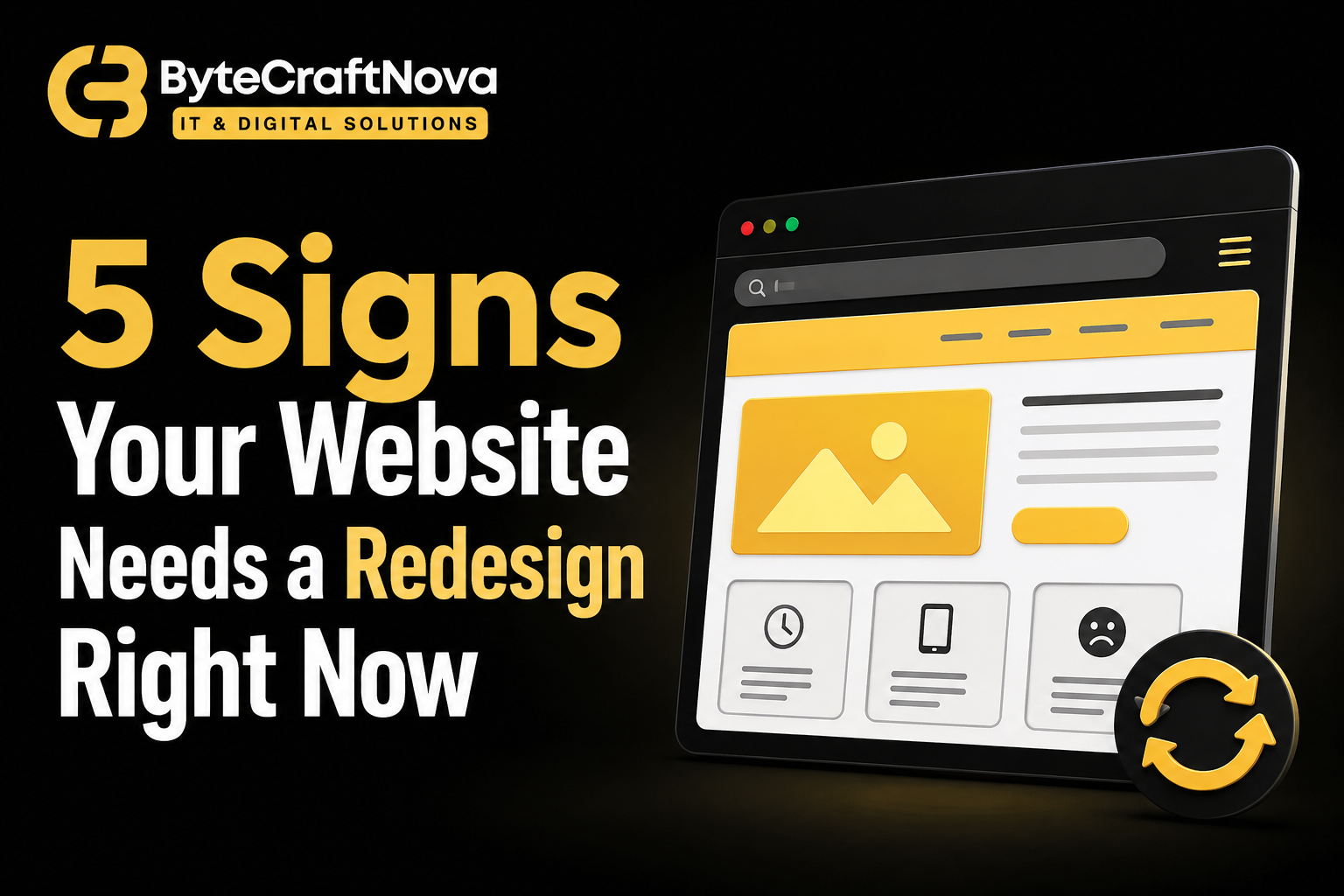
In this guide, we’ll walk you through the five clearest signs your website needs a redesign right now, a bonus sign most business owners miss, what it actually costs you to ignore these red flags, a simple self-check checklist you can use today, and answers to the most common questions business owners ask before starting a redesign project.
Sign #1: Your Website Looks Outdated (Design & Branding Mismatch)
Design trends move fast, and what looked modern five years ago can feel dated today. Clunky layouts, tiny fonts, low-quality images, and cluttered pages send a subtle but powerful message to visitors: this business hasn’t kept up with the times.
This matters more than most business owners realize. Studies on first impressions consistently show that visitors form an opinion about a website and, by extension, the business behind it within seconds of landing on the page. If your site still reflects who your business was two or three years ago, it may be quietly pushing potential customers toward a competitor with a fresher, more trustworthy-looking site.
An outdated website design is one of the most common signs your website needs a redesign, especially if your branding, colors, or messaging no longer match where your business is today.
Here are a few practical ways to spot outdated design before a visitor points it out to you:
- Inconsistent branding Your logo, colors, or fonts on the website don’t match your current business cards, social media, or physical signage
- Stock photography that feels generic Overused stock images can make even a legitimate, established business feel less authentic
- Cluttered layouts Too many competing elements on one page overwhelm visitors instead of guiding them
- Outdated visual trends Heavy drop shadows, flash-style animations, or tiny centered text blocks are dead giveaways of an older build
It’s worth remembering that design isn’t just about looking “nice.” A modern, clean design builds subconscious trust. Visitors are far more likely to share their contact information, make a purchase, or reach out for a quote when a website feels current and professionally maintained.
Sign #2: It’s Painfully Slow to Load
Page speed isn’t just a user experience issue anymore it’s a ranking factor. Google’s Core Web Vitals now directly influence search rankings, and a slow-loading site is penalized by both search engines and impatient users.
If your Largest Contentful Paint (LCP) takes longer than 2.5 seconds, you’re likely losing visitors before they even see your content. People expect instant results, and a sluggish website feels broken, even if the content itself is great.
Slow website loading speed is frequently caused by outdated code, bloated plugins, unoptimized images, or an aging content management system all classic reasons a full redesign, rather than a quick patch, becomes necessary.
Common culprits behind a slow website include:
- Heavy, uncompressed images that were never optimized for the web
- Too many third-party scripts and plugins running simultaneously
- An outdated hosting environment that can’t keep up with modern traffic
- Bloated, unoptimized code accumulated from years of small edits and patches
While tools like image compression or caching plugins can offer temporary relief, they rarely solve the underlying problem. If your website’s foundation is old, a redesign built on a modern, lightweight framework is usually the only long-term fix.
Sign #3: It’s Not Mobile-Friendly (And Google Notices)
More than half of all web traffic today comes from mobile devices. If your website isn’t optimized for smaller screens, you’re effectively closing the door on a majority of your potential customers.
A few quick ways to check if your website is not mobile-friendly:
- Pages look “smushed” together or require zooming in to read text
- Buttons and links are too small or too close together to tap accurately
- Menus don’t collapse properly on smaller screens
- Forms are difficult to fill out on a phone
Google also uses mobile-first indexing, meaning it primarily evaluates the mobile version of your site when determining search rankings. A poor mobile experience doesn’t just frustrate visitors it actively hurts your visibility in search results.
It’s also worth considering how mobile behavior differs from desktop. Mobile visitors are often searching with more immediate intent looking for a phone number, an address, or a quick answer. If your mobile site makes that information hard to find, you’re likely losing exactly the customers who were closest to taking action.
Sign #4: High Bounce Rate and Low Conversions
Traffic without action is one of the most frustrating problems a business owner can face. You might be getting visitors, maybe even paying for ads, but if people land on your site and leave without calling, filling out a form, or making a purchase, something in the experience is broken.
A high bounce rate combined with low conversions usually points to deeper structural issues, such as:
- An unclear value proposition (visitors don’t understand what you offer within seconds)
- Confusing navigation that makes it hard to find information
- Weak or missing calls-to-action
- A layout that doesn’t guide visitors toward the next step
A pretty website that doesn’t convert is really just an expensive brochure. This is one of the signs your website needs a redesign that directly affects your bottom line, not just your appearance.
A well-planned redesign addresses this by focusing on user experience (UX) the way visitors move through your site, how quickly they understand your offer, and how naturally they’re guided toward taking action, whether that’s making a call, filling out a form, or completing a purchase. Small changes to page structure and messaging often produce significant improvements in conversion rates, sometimes even more than a visual “facelift” alone.
Sign #5: It’s Not Showing Up on Google (Poor SEO Structure)
If your website was built years ago using an outdated content management system or a rigid template, chances are its underlying SEO structure is holding it back. Issues like poor URL structures, missing header tags, slow code, and non-crawlable navigation all make it harder for search engines to understand and rank your pages.
A modern redesign isn’t just about aesthetics it’s an opportunity to fix these foundational SEO issues by improving site architecture, optimizing page titles and meta tags, and making your content easier for both search engines and users to navigate.
If your organic traffic has been steadily declining, or you’ve noticed competitors consistently outranking you for the same searches, poor SEO structure is likely a major contributing factor.
Bonus Sign: Your Competitors’ Websites Look Way Better
Sometimes the clearest sign is simply comparison. If you visit a competitor’s website and immediately feel like theirs looks more professional, loads faster, or is easier to use, your customers are likely noticing the same gap.
In a digital-first world, your website is often compared to your competitors before a customer ever picks up the phone or walks through your door. Falling behind visually and functionally can quietly cost you business, even if your product or service is superior.
What Happens If You Ignore These Signs?
Delaying a redesign rarely makes the problem disappear it usually makes it worse. Here’s what continuing to ignore these signs can cost your business over time:
- Lost revenue Every visitor who leaves due to a slow, confusing, or outdated site is a potential sale walking away
- Declining search rankings Search engines increasingly favor fast, mobile-friendly, well-structured websites
- Damaged brand credibility An outdated site can make even an established, trustworthy business look unreliable
- Rising technical debt The longer an old site remains untouched, the more expensive and complex it becomes to fix later
Waiting for “the right time” often means losing customers to competitors who’ve already made the investment.
Quick Self-Check: Website Redesign Checklist
Not sure where your website stands? Run through this quick checklist:
- My website hasn’t been updated in the last 2–3 years
- My site takes more than 3 seconds to load
- My website looks broken or hard to use on mobile
- Visitors leave quickly without taking action
- My website rarely shows up on Google search results
- My competitors’ websites look noticeably more professional
If you checked two or more boxes, it’s a strong sign your website needs a redesign sooner rather than later.
How to Get Started With a Website Redesign
Once you’ve recognized the signs, the next step is deciding how to move forward. While some minor issues can be fixed with small updates, most of the signs discussed above point to deeper structural problems that require a more comprehensive solution.
This is where partnering with an experienced web development company makes a real difference. A professional website development company doesn’t just make your site look better they rebuild it with the right technical foundation: fast-loading pages, mobile-first design, clean SEO structure, and a user experience built to convert visitors into customers.
When choosing a web development company for your redesign, look for one that takes time to understand your business goals, shows previous work, and explains their process clearly rather than just offering generic templates.
Frequently Asked Questions
How do I know if my website needs a redesign?
The clearest indicators are an outdated visual design, slow loading speed, a poor mobile experience, high bounce rates with low conversions, and declining visibility on search engines. If two or more of these apply to your site, it’s a strong sign your website needs a redesign.
How often should you redesign your website?
As a general benchmark, most websites benefit from a redesign every three to five years. However, the real trigger isn’t the calendar it’s whether your site is still effectively representing your business and converting visitors.
What happens if you don’t redesign your website?
Ignoring the signs typically leads to declining search rankings, lost revenue from visitors who leave without converting, damaged brand credibility, and a website that becomes increasingly expensive to fix the longer it’s left untouched.
How much does a website redesign cost? Costs vary widely depending on the size of your website, the complexity of features required, and the web development company you choose. A simple redesign for a small business site typically costs less than a large-scale e-commerce or custom web application redesign.
Conclusion
A website redesign isn’t just a cosmetic upgrade it’s an investment in how your business is perceived, how easily customers can find you, and ultimately, how much revenue your site generates. If you recognized even a few of the signs your website needs a redesign discussed in this guide, it’s worth taking action before the cost of waiting grows any larger.
Not sure where your website stands? Get a free website audit and consultation from our team we’ll show you exactly what’s working, what’s not, and what a redesign could do for your business.