Let me guess. Someone told you that you need SEO. Maybe you Googled it. Now you have 47 tabs open and you are more confused than when you started.
You are not alone.
We have worked with 100+ businesses across the US, UK, Australia, Canada, and Dubai, ranging from fashion brands and home decor stores to B2B surveillance companies and career coaching platforms. And the number one thing almost every business owner says when they first come to me is the same thing: “I kind of know SEO is important, but we have no idea what it actually means for my business.”
This guide what is SEO for small businesses in 2026 fixes that. No jargon. No textbook definitions. Just plain English, real examples, and a clear starting point for your business.
What is SEO, Really? (No Jargon, Just Plain English)
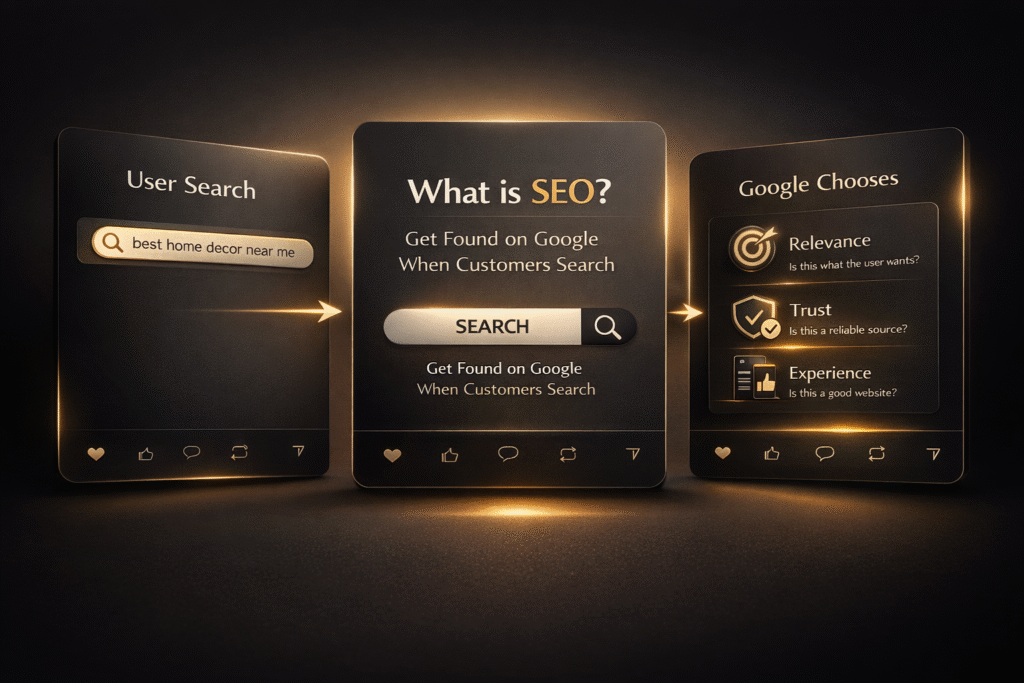
SEO stands for Search Engine Optimization. But forget the acronym for a second.
Here is what it actually means: SEO is the process of making your business show up on Google when your ideal customer is searching for what you sell.
That is it.
When someone in Melbourne types “best home decor store near me” or someone in Delhi searches “affordable B2B door hardware supplier,” Google goes through millions of websites in seconds and decides who shows up first. SEO is the work you do to make sure your website is the one Google picks.
Think of Google as the world’s biggest referral network. SEO is how you earn that referral.
How Google Decides Who Ranks First: The Simple Version
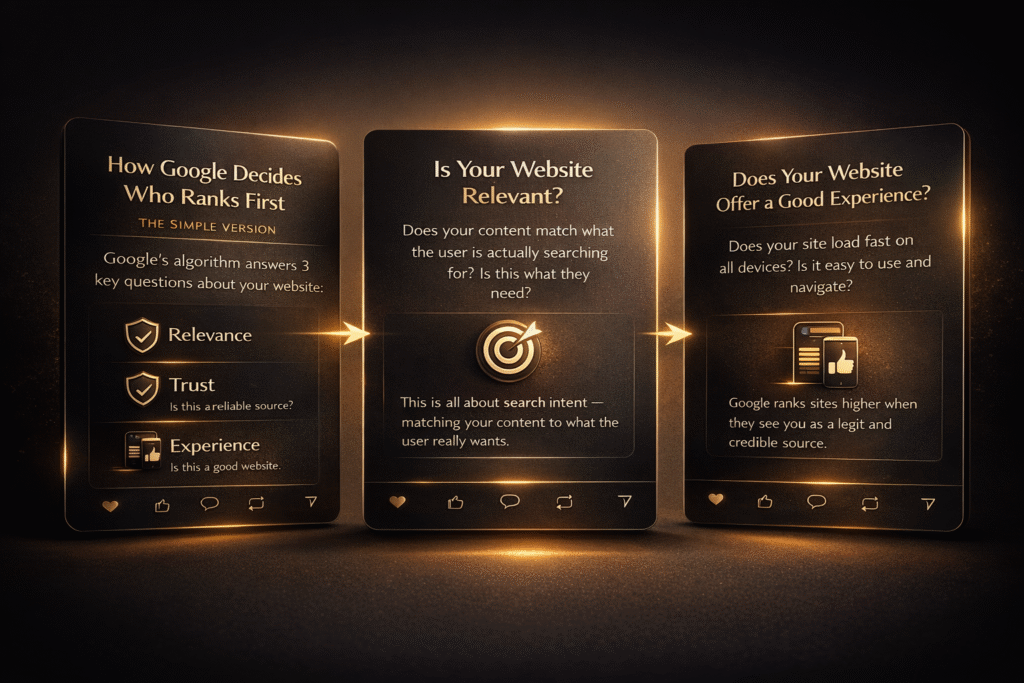
Google uses a system called an algorithm to rank websites. You do not need to understand the whole algorithm. But you do need to understand the three things Google is always asking about your website.
Is this website relevant? Does your content match what the user is actually searching for? This is called search intent, and it is honestly the most underrated part of SEO. Most business owners start doing SEO without ever thinking about intent. They chase keywords without asking: what does this person actually want when they type this?
Is this website trustworthy? Does Google see your site as a credible source? This comes from things like other websites linking to you, how long your site has been around, and whether your content demonstrates real expertise.
Is this website a good experience? Does your site load fast? Does it work on mobile? Is it easy to navigate? Google cares deeply about this because a bad website experience means a bad Google experience.
Every single SEO activity you will ever do comes back to answering yes to these three questions.
The 3 Pillars of SEO Every Business Owner Must Know
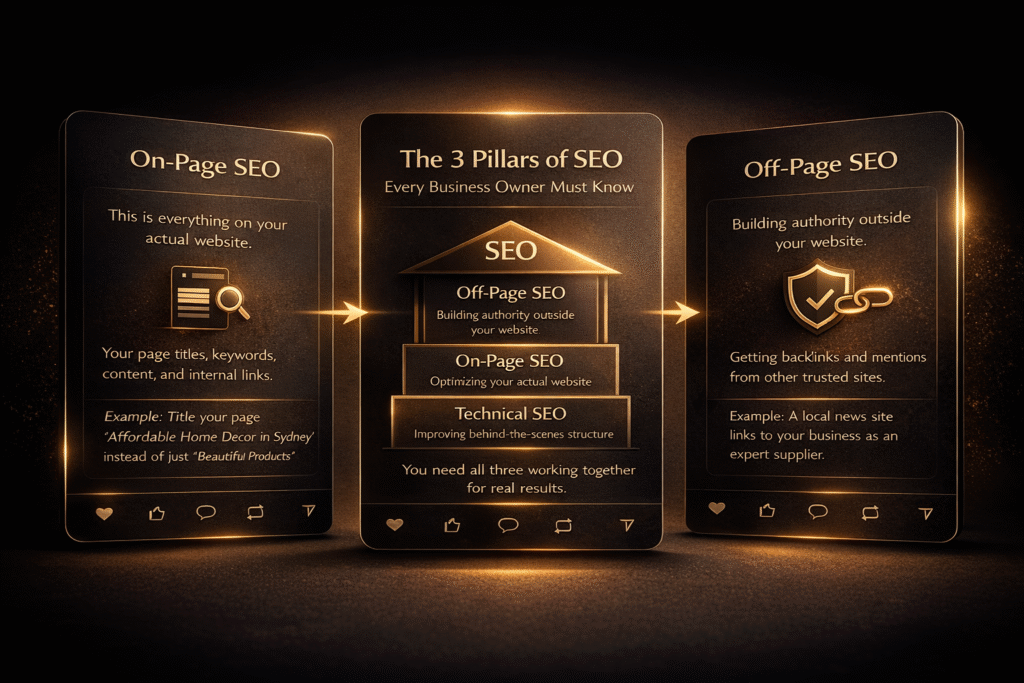
SEO has three main areas. You need all three working together for real results.
On-Page SEO
This is everything on your actual website. Your page titles, headings, the content you write, the keywords you use, your images, and your internal links. On-page SEO is what you have the most direct control over and where most small businesses should start.
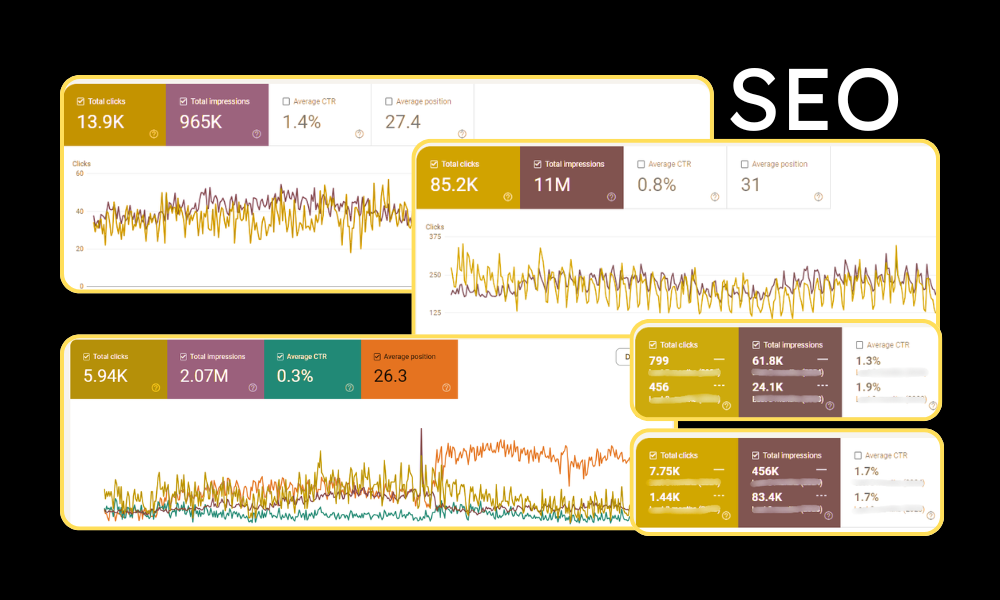
A practical example: if you run a home decor business in Sydney, having a page that says “Beautiful Products” in the title does nothing for you. Changing it to “Affordable Home Decor in Sydney” tells Google exactly what you sell and who you sell it to. We worked with a home decor brand that made this exact kind of shift across its entire site. The result was 50 million plus impressions, a 1.4% click-through rate, 3,000 to 4,000 keywords ranked, and over $900 in direct sales generated purely from organic traffic without spending a single dollar on ads.
That all started with getting the basics of on-page SEO right.
Off-Page SEO
This is everything that happens outside your website that builds your authority. The biggest factor here is backlinks, which are other websites linking to yours. When a respected website links to you, Google treats it like a vote of confidence.
Think of it this way. If 50 respected people in your industry say “this business is great,” Google pays attention. If nobody is talking about you online, Google has no reason to trust you.
Getting backlinks does not have to be complicated at the start. Getting featured in a local business directory, being quoted in an industry article, or having a supplier link to your website are all simple ways to start building off-page authority.
Technical SEO
This is the behind-the-scenes stuff. How fast your website loads, whether it works properly on mobile, whether Google can even read and understand your site structure. Technical SEO is like the foundation of a house. You do not see it, but without it, everything else falls apart.
The good news is that for most small business websites, fixing the major technical issues is a one-time job. Once your site loads fast, works on mobile, and is properly indexed by Google, you can focus most of your energy on on-page and off-page work.
SEO vs Paid Ads: Which One is Right for You Right Now?
This is one of the most common questions we get, and the honest answer is: it depends on where you are in your business journey.
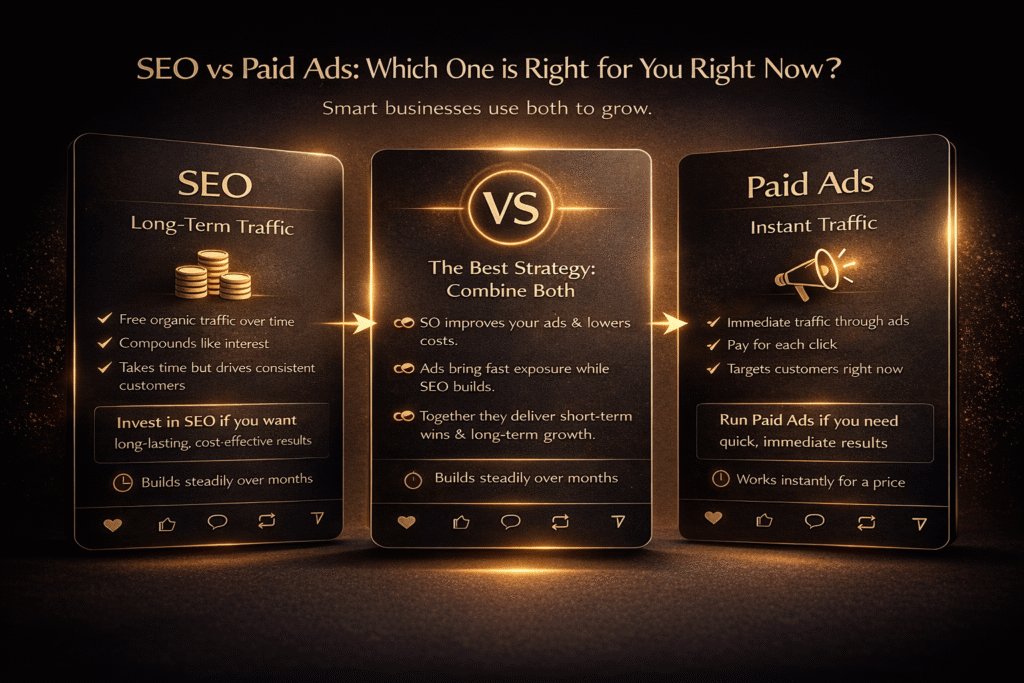
Here is something most people do not know though. SEO and paid ads are not competitors. They actually work together in a way that most agencies will never tell you about.
When you run Google Ads, Google gives your ad a Quality Score. This score directly affects how much you pay per click and how often your ad shows up. One of the biggest factors in your Quality Score is the relevance and quality of the landing page your ad points to, which is essentially your on-page SEO.
We have seen businesses significantly cut their cost per click just by improving the SEO quality of the pages their ads were pointing to. Better on-page SEO means a higher Quality Score, which means lower bidding costs and better ad placement. So if you are running Google Ads right now, investing in SEO is not just a long-term play. It is actively saving you money today.
Here is a simple way to think about the difference. If you need customers this week, start with paid ads because SEO takes time to build. If you want customers coming to you consistently without paying for every single click, invest in SEO because it compounds over time like interest in a bank account. The smartest businesses do both and let them work together.
Local SEO: The Fastest Win for Small Businesses
If you are a small business serving a specific city or region, local SEO for small business is your single biggest opportunity right now.
Local SEO means optimising your business to show up when people nearby search for what you offer. That “near me” type of search is growing every single year and Google prioritises local businesses in those results above almost everything else.
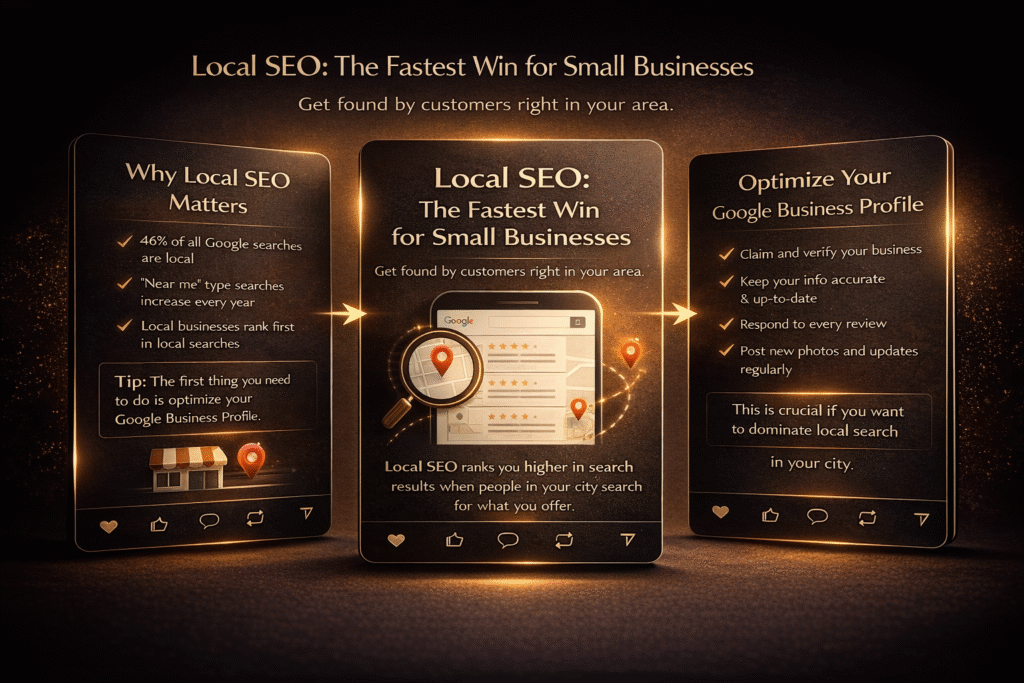
The first and most important step is setting up and optimising your Google Business Profile. This is completely free. When someone searches for your type of business in their area, your Google Business Profile is what shows up in the map section right at the top of the page.
Here is what most businesses get wrong. They set it up once and forget about it. The businesses that dominate local search are the ones posting updates regularly, responding to every single review, adding fresh photos, and keeping all their information accurate and up to date.
For the Indian market specifically, local SEO has some of the lowest competition of any English-speaking market right now. A well-optimised Google Business Profile and a few localised blog posts can get you ranking faster in India than almost anywhere else. If you want to see exactly how to do this step by step, we cover the full process in our [local SEO checklist for small businesses].
For businesses in the UK, ranking on the first page of Google is more competitive but very achievable with the right approach. We break that down in detail in our guide on [how to get your business on the first page of Google].
How Long Does SEO Actually Take? (The Honest Answer)
We am going to be straight with you because most people in this industry are not.
SEO takes time. For a brand new website with no authority, you are typically looking at 3 to 6 months before you see meaningful organic traffic. For competitive keywords in competitive markets, it can take longer.
But here is what nobody tells you. The results compound.
With paid ads, the moment you stop paying, the traffic stops. With SEO, every blog post you publish, every backlink you earn, and every page you optimise is an asset that keeps working for you month after month. The home decor brand we mentioned earlier did not get to 50 million impressions overnight. But once the momentum built, it kept building without ongoing ad spend.
That does not happen in month one. But it does happen, and once it does, it keeps growing.
How to Start SEO for Your Business: 5 Simple First Steps
You do not need to do everything at once. Start here and do these five things before anything else.
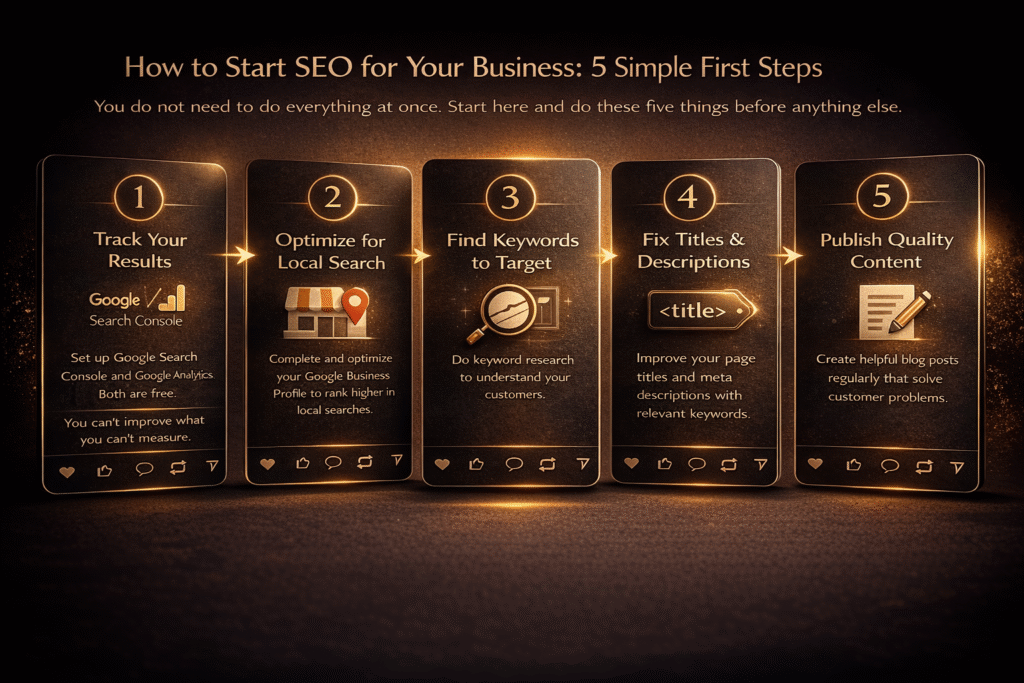
Step 1: Set up Google Search Console and Google Analytics. Both are free. Search Console shows you what keywords people are using to find your site. Analytics shows you what they do once they arrive. You cannot improve what you cannot measure, so this is non-negotiable.
Step 2: Optimise your Google Business Profile. Fill out every single field. Add real photos of your business. Write a proper description that includes your main keywords naturally. Start actively collecting reviews from happy customers.
Step 3: Do keyword research before you write anything. Use free tools like Google Keyword Planner or Ubersuggest. Find out what your customers are actually typing into Google, not what you assume they are typing. Understanding [search intent and keyword research] changes everything about how you create content.
Step 4: Fix your page titles and meta descriptions. Go through your main website pages right now. Make sure every title clearly states what that page is about and includes a relevant keyword. This single change can improve your click-through rate from Google results almost immediately.
Step 5: Start publishing helpful and specific content consistently. One well-written blog post per week that genuinely answers a question your customer is asking is worth more than ten generic posts stuffed with keywords. Consistency beats volume every single time.
The Biggest SEO Mistakes Small Business Owners Make
After working with over 100 businesses across four continents, these are the mistakes we see most often.
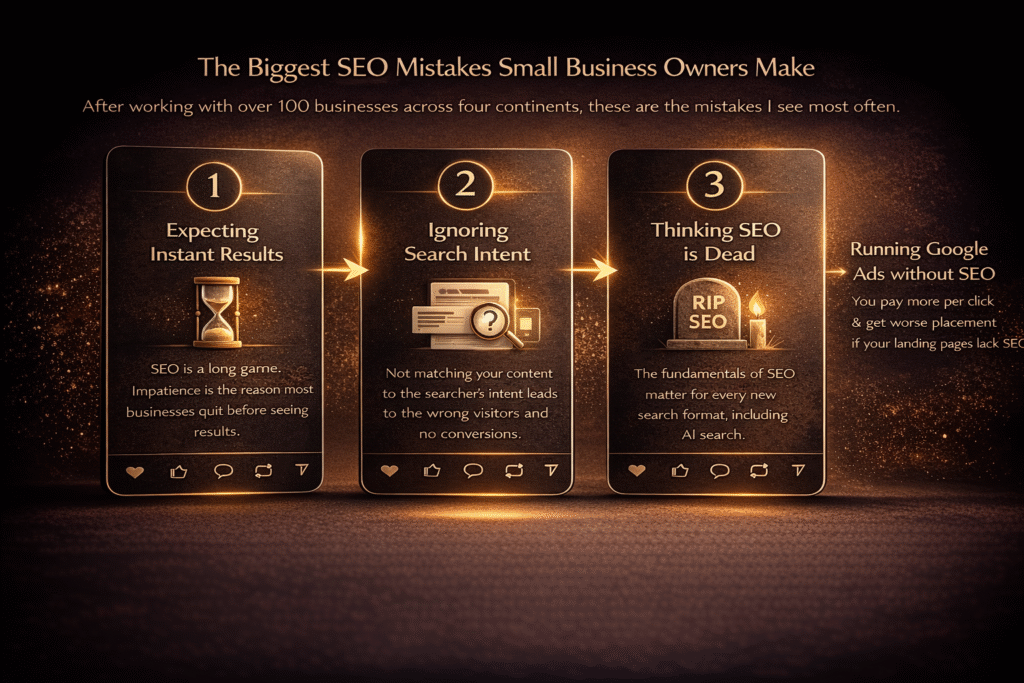
Expecting instant results. The number one misconception we deal with is business owners expecting to rank on page one within a week of starting SEO. We get this question constantly. It does not work that way. SEO is a long game, and impatience is the reason most businesses quit before they ever see results.
Ignoring search intent. Most businesses start doing SEO by targeting keywords without ever asking what the person searching that keyword actually wants. Someone searching “what is SEO” wants education. Someone searching “SEO agency for my business” wants to hire someone. Same general topic, completely different intent. Targeting the wrong intent means you attract the wrong visitors, and they leave without ever converting.
Thinking SEO is dead. Every year, someone declares SEO is finished because of a new trend. Right now, the conversation is around GEO (Generative Engine Optimization) and AEO (Answer Engine Optimization) because of AI tools like ChatGPT and Google AI Overviews. Here is the truth. Those AI tools pull their answers from content that already ranks well in traditional search. If your SEO foundation is weak, generative AI tools will not surface you either. The fundamentals of SEO are the foundation for every new search format that exists today, including AI search.
Running Google Ads without SEO. As we mentioned earlier, your ad Quality Score is directly connected to the quality of your landing pages. Businesses spending money on Google Ads without any SEO work are paying more per click than they need to and getting worse placement than they should. Improving your digital marketing cost efficiency starts with understanding how SEO and ads work together.
What to Do Next
SEO is not magic. It is not mysterious. It is simply the process of making your business easy for Google to understand, trust, and recommend.
Start small. Set up your Google Business Profile today. Install Search Console this week. Write one genuinely helpful blog post this month. Then do it again next month.
The businesses that win at SEO are not the ones with the biggest budgets. They are the ones that show up consistently over time.
If you want a step-by-step SEO plan built specifically for your business, get in touch. We have helped businesses across the US, UK, Australia, and India grow their organic traffic from zero, and we can help you do the same.
FAQ
Is SEO still worth it in 2026 with AI search growing?
Yes, and here is why. AI tools like ChatGPT, Google Gemini, and Perplexity pull their answers from content that already ranks well in traditional search. If your website has strong SEO foundations, you are more likely to be cited by these AI tools as a source. Ignoring SEO today means being invisible on both traditional search and AI-generated answers tomorrow.
How much does SEO cost for a small business?
It depends on whether you do it yourself or hire someone. DIY SEO using free tools like Google Search Console, Google Analytics, and Ubersuggest costs nothing but time. Hiring a professional typically ranges from $500 to $3,000 per month, depending on your market and goals. We break down exact numbers by market in our guide on digital marketing costs for small businesses.
Can I do SEO myself as a business owner?
Absolutely. The basics of SEO, optimising your Google Business Profile, writing helpful content, and fixing your page titles, are all things a business owner can do without any technical background. As your business grows, you can bring in a specialist for the more advanced technical work.
How do I know if my SEO is working?
Track these three numbers every month. Organic traffic in Google Analytics to see if more people are finding you through search. Keyword rankings in Google Search Console to see if you are moving up for your target keywords. And leads or sales coming from organic traffic to see if the traffic is actually converting. Numbers do not lie. If all three are moving up, your SEO is working.